Pages

Free Image Hosting Free Image Hosting
Showing posts with label fantasy. Show all posts

Monday, April 11, 2011

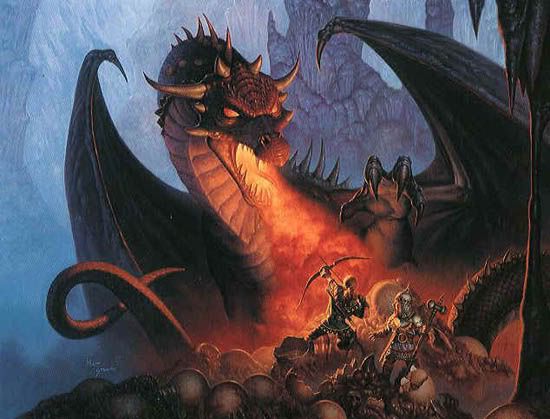
Dungeons and Dragons

Dungeons and Dragons (D&D) is a fantasy role playing game that exists since the mid 1970s. Over the years it has gained a lot of popularity, and at this point it is by far the most popular pen & paper role playing game in the market, with book and equipment sales of more than $1 billion and more than 20million people that have played it, according to wikipedia.


The game is an open-ended and story-based, governed by a very complex set of rules that take a while to master. D&D requires at least 4-5 participants to be interesting, one of which is the Dungeon Master (DM). The rest of the players each assume a character and typically form a group. Each character has some statistics that represent what they can do, as well as backgrounds that merge into the story.

The Dungeon Master is responsible for providing the setting in which the characters act. The DM is the one narrating the story and playing all the non-player characters (NPCs) that appear in the plot. The DM also describes to the players the environment, the actions that happen and how the story evolves. (S)he is the one providing challenges to the players to overcome, as well as helping them when needed. To do all the above requires an intimate familiarity with the game rules as well as a creative spirit. A good Dungeon Master is the key to having a nice experience while playing the game.


There is a lot of literature that has been developed around the game. Whole fantasy worlds have been created and thousands of novels have been written describing stories that take place in these worlds. These books often act as inspiration to help the Dungeon Master create the stories for the players.

To start playing the game, a group of players needs 3 books. The Player's Handbook contains the core rules of the game that everyone needs to know. The other two books, the Monster Manual and the Dungeon Master's Guide are important mostly to the DM. In addition to these core rulebooks, there are tons of enhancements and additional tools available to help enhance the playing experience.


Other than these books (which you have to read before starting to play!), all you need is few sets of dice, pen, paper, maybe some miniatures and a lot of imagination!


Tuesday, April 5, 2011

Vampire: The Masquerade

"Vampire: The Masquerade" is a fantasy pen & paper role playing game that was created in the early 1990s and has become ever since one of the most popular games of its kind.


The game is themed around the concept of vampirism which is very popular in literature since the medieval ages. In this context, the game explores various aspects of human personality, such as "themes of morality, depravity, the human condition (or appreciation of the human condition in its absence), salvation, and personal horror."  

Each Vampire belongs to a distinct clan or bloodline. These groupings share distinct characteristics, powers and curses. The Nosferatu, for example, all share the disciplines of Animalism, Obfuscate and Potence and the curse of disfiguring appearance. A bloodline is a distinct split from the main clans, as the curse of Caine is changed over time, representing new expressions of vampirism. Some bloodlines, such as the Gargoyles, are artificially created through applications of Thaumaturgy. The Caitiff are an exception to the rule, as they are considered clanless sharing no disciplines and curse, they are viewed as a disquieting sign of the coming armageddon.

The game plays out like a classic pen&paper RPG, with a storyteller or game-master narrating a story and setting the environment, and the players describing their characters' actions within that setting. According to their actions the characters stay closer to their human side or their "beast" side.

Based on the pen & paper game, a PC game was developed in 2004, Vampire: The Masquerade - Bloodlines, which became a best-seller. 

Find more information and user reviews about Vammpire: The Masquerade Products on Amazon:


Tuesday, March 8, 2011

Introduction to Pen and Paper Role Playing Games

Pen and paper role playing games (RPGs) is a very popular category of fantasy games where players assume the role of a character and describe their actions through speech and/or using miniatures. In each pen and paper RPG, there is a comprehensive systems rule that describes the traits and abilities of each character and what actions they can perform. These games are typically turn-based, which means that each character may perform actions when their turn comes in a pre-determined, often randomized, cycle.
Pen and paper RPGs are played in small social gatherings, most often at home but occasionally on coffee shops and sometimes even at specially designed venues where big gatherings take place and even tournaments.

In a pen and paper RPG, the players create their characters (usually before the actual gaming session takes place) according to the specific rules of each game. The game rules dictate possible backgrounds and qualitative characteristics but also some numerical statistics. Many players usually go beyond the game rules to include sketches of how their character looks like and fine tune the whole role playing process.

After the characters have been created, the game procedure is being initiated by the Game Master (GM). The Game Master is usually a person well - versed in the rules of the specific game whose responsibility is to narrate a story and create the background for the players to act. Among the GM's responsibilities are to prepare the setting and the context where the game takes place, to play the role of all miscellaneous characters appearing in the plot interacting with the players, to describe events that take place, to  and even adjudicate disputes when they arise.


Most of these games rely on using various types of dice to introduce an element of randomization to the game and actually make it feel more alive. Several of the most popular pen and paper games have been implemented as PC games in the past, becoming blockbusters. The blooming category of massive multiplayer online RPGs that have conquered the PC gaming world have their roots in  these pen and paper games.

In subsequent posts we will explore several of the most popular pen & paper RPGs in more depth.

Wednesday, February 23, 2011

Warhammer 40k

Warhammer 40000 is a miniature board game based on dice rolling. Players use painted miniatures representing futuristic combat units. Groups of these miniatures comprise armies that are used to fight against other armies of other players. The players choose a battle scenario and play on a table without a board. Miniatures are moved physically on the board according to the game rules.

The game itself is considered a form of art in terms of painting the miniatures. Out-of-the box miniatures come unpainted, and most players spend a great deal of time painting them (which is a rather long and detailed procedure) to greatly enhance their looks. Painting the Warhammer 40k miniatures is not mandatory for playing the game but it makes the battlefields during the actual play look a lot better.


Each miniature of Warhammer 40k has its own statistics that determine its power and abilities in combat. Actions take place based on dice rolls according to a complex amount of rules. Terrain also plays an important role in the outcome of combat and the game's publisher has released several terrains appropriate for combat. The distance between units also plays a role in the outcome of combat, therefore rulers are being used during the game.

Ratings:

Fun factor: Very High. The complexity of the game along with a great variety of units and miniatures make it extremely funny to play. Warhammer 40k players tend to spend many hours playing each time they gather.

Cost: High - Very High. There are a lot of miniature sets available and buying those miniatures as well as the appropriate paint costs a great deal of money for a board game. Thus the game appeals mostly on collectors.

Complexity: Medium - High. The rules are straightforward in general but there are many exceptions one has to learn to play correct.

Duration: Varies depending on the scenario and the amount as well as the experience of players

Replayability: Very high. Customization of terrain along with the large amount of available miniatures offer endless possibilities.


Find more information and user reviews about Warhammer 40k products on Amazon: